2023年11月23日星期四

Precautions for Using Ladles

When the ladle is used for the first time, all parts of the ladle must be thoroughly inspected. Parts such as gantry hooks, various protective devices, and safety forks should be inspected in particular detail. If damage is found, it should be replaced in time. The steel ladle must be inspected with 2 times the load during initial use.

Precautions for Using Ladles

Precautions Before Using the Ladle

Repair of ladle lining. Refractory materials, including refractory bricks, refractory mortar, and refractory mud, should be appropriately selected according to the type of molten steel. For example, ordinary carbon steel uses silicon refractory materials; ordinary alloy steel uses aluminum refractory materials; manganese steel uses magnesium refractory materials.

When using a plug-rod ladle, the ladle nozzle and refractory layer must be constructed in the following order.

(1) Install the sprue brick at the nozzle at the bottom of the package. The sprue brick should be paired with the plug brick and ground before installation.

(2) Install the seat brick.

(3) Use refractory bricks to build the bottom and walls of the ladle. The bottom part of the bag should be sloped 1/20 towards the water outlet. For the used package body, if the corrosion of the refractory layer is not large, you can only replace the refractory bricks at the nozzle and repair part of the refractory layer.

Refractory Bricks for Steel Ladle

(4) Before using the plug rod, the resistant material must be constructed in the following order. Insert the stopper rod through the ground stopper brick and secure it in place. Place the sleeve brick on the plug rod, and fill the space between the sleeve brick hole and the plug rod with dry fine sand or asbestos powder. The contact surfaces of plug head bricks and sleeve bricks should be coated with refractory mud. Add a pressure cap to the end of the sleeve brick, and use a nut to tighten the sleeve brick through the gland.

Installation of sliding spouts. First, install the sliding nozzle well bricks, and then build the refractory material according to the specified thickness of the refractory material.

Ladle baking

Install the plug rod filled with refractory material on the cross arm. During installation, the concentricity of the plug brick and the sprue brick must be adjusted to ensure sealing. After the adjustment is completed, use nuts to reliably fix the plug rod and the transverse hip.

After assembly, the newly repaired refractory ladle should be thoroughly baked 6 hours before use. The baking temperature should be gradually increased from low to high (800℃, constant temperature for 1 hour).

Lower the hanger while the ladle is baking. The drying bag can be used with gas or natural gas. The baking time of used ladles can be shortened. However, the baking time should not be less than 2 hours, and the baking temperature should not be lower than 800℃.

Precautions for Casting Use

1. Before casting, first check whether the safety fork is reliable.

2. Align the pouring opening of the pouring ladle with the opening of the pouring cup of the mold.

3. Before pouring, use the lever to press the plug rod and loosen the locking bolt at the same time to make the pouring ladle in the poured state. When pouring, slowly lift the plug rod, and the molten metal will flow out from the bottom nozzle. The greater the lifting distance of the stopper rod, the greater the flow rate of molten metal. Therefore, the pouring speed can be controlled using a lever.

4. After pouring, check whether the sprue bricks, plug bricks, and sleeve bricks at the nozzle are severely corroded, cracked, or otherwise damaged. If it is damaged, it should be replaced. If it is not damaged, the adhered metal residue or other adherents should be cleaned and maintained for use. Under normal circumstances, the sprue bricks, plug bricks, and sleeve bricks need to be replaced after one package of molten steel.

5. When using the sliding nozzle ladle, pay attention to the drainage sand in the nozzle. When pouring a casting, first open the sliding nozzle mechanism to release a portion of the molten steel (release the drainage sand). Prevent the drainage sand from rushing into the casting and affecting the quality of the casting.

After the ladle is used, the bad refractory materials should be removed and the refractory materials should be rebuilt. At the same time, inspect the pouring ladle, including hoists, lifting rings, beams, safety devices, stopper rods stopper rod driving devices, and sliding nozzle devices.

2023年10月30日星期一

Acid-Resistant Castables for Lining of Acid-Resistant Chimneys and Liquid Sulfur Pools

Acid-resistant castables are divided into heavy, semi-light, and light. Their main function is to be used for furnace linings that resist acid erosion. Acid-resistant castables are generally combined with acid-resistant cement and are applicable to acid-resistant chimneys and liquid sulfur pool linings in the petrochemical industry.

Acid-Resistant Castables for Lining of Acid-Resistant Chimneys

The acid-resistant castable for acid-resistant chimneys is similar to and different from other refractory castables. It belongs to an acidic medium. During production, the raw materials are also processed into granules and fine powder in an acidic medium, and a certain proportion of ultra-fine powder and additives are added. However, the acid-resistant castable used for lining the liquid sulfur pool cannot be used in atmospheres with large temperature differences, nor can it be used in construction in places that are too humid. If the temperature is not suitable, it will reduce the later use strength and acid resistance of the acid-resistant castable, and it will peel off.

Application of acid-resistant castables

Chimneys are made of acid-resistant castables, generally semi-lightweight. It can not only be used for thermal insulation but also be resistant to erosion and acid gas erosion. Because semi-lightweight acid-resistant castables can save energy and improve the operation rate and service life of the chimney. At the same time, the weight of the chimney body is not too heavy.

Application of acid-resistant castables

Acid-resistant refractory castables are all used in furnace linings that resist acidic atmospheres and cannot be used in neutral or alkaline furnace-lining atmospheres. Due to the high-temperature resistance of acid-resistant castables, it is not as good as high-aluminum series castables used in neutral atmospheres. In an alkaline atmosphere, use castables inferior to the magnesium series. It is mainly used in acidic atmosphere chimneys, flues, nitric acid shrink tower linings, and acid gas container linings. The high-temperature resistance of acidic refractory castables is not as good as that of the high aluminum series and magnesium series.

However, acid-resistant castables can be used as separate lining materials. When used in a furnace with a consistent atmosphere, the castable's own acid resistance will be exerted, and it cannot be used as a furnace lining in other atmospheres. First, there is a gap in high-temperature resistance, and then there is a gap in resistance to erosion by other atmospheres.

In other words, acid-resistant castables, whether heavy, semi-light, or light, can only be used as furnace linings for acid gases.

Lightweight acid-resistant castable for anti-corrosion flue

Lightweight acid-resistant castable is mainly used in anti-corrosion flue and chimney linings, acid storage tanks, pickling tank linings, and nitric acid shrinkage tower linings. Acid recovery furnace lining and other refractory castables corroded by acidic high-temperature gases. It can improve the air tightness and integrity of the lining wall and the corrosion resistance of the lining. It is a kind of refractory material that is widely used at present.

Lightweight acid-resistant castable

Characteristics of lightweight acid-resistant castables for chimney lining

1. It has the characteristics of light volume and high compressive strength.

2. It is resistant to acid and acid gas corrosion.

3. It has the characteristics of heat insulation, heat preservation, and low water absorption.

4. It can significantly improve the air tightness, integrity, and anti-corrosion ability of the lining.

Characteristics of lightweight acid-resistant castables for lining pickling tanks

1. Low thermal conductivity. The thermal conductivity of lightweight acid-resistant castable is only 0.12-0.16W/(m·k), which is about 1/10 of ordinary concrete. Therefore, the thermal insulation effect can be better exerted.

2. High temperature resistance. The castable can be used for a long time in a high-temperature environment of 1000°C without cracking or falling off. Excellent fire resistance.

3. Strong corrosion resistance. Lightweight acid-resistant castable has good acid and alkali corrosion resistance. It can be used for a long time in corrosive environments such as strong acids and alkalis without causing damage or destruction.

4. Simple construction. The castable is easy to construct and uses water as a diluent. It can be mixed with water on-site to form a slurry and then poured directly on the surface of the equipment. No special construction equipment or technology is required. The labor intensity and construction difficulty of workers are greatly reduced.

The characteristics of the lightweight acid-resistant castable used for lining the acid recovery furnace enable it to be widely used as a lightweight acid-resistant castable. At the same time, as an unshaped refractory castable, it can also be made into prefabricated parts of various shapes for use. It is a refractory product that is widely used and ideal at present.

2023年10月7日星期六

What factors should be considered when purchasing circulating fluidized bed furnace lining refractory materials?

The circulating fluidized bed boiler has strong fuel adaptability, good combustion stability, a simple preparation system, and a long service life. Widely used in metallurgy, chemical industry, electric power, construction, and other fields. The normal operation of a circulating fluidized bed boiler is inseparable from the lining with reasonable structure, wear resistance, and fire resistance. How to choose circulating fluidized bed furnace lining refractory materials? What factors should be considered when purchasing circulating fluidized bed furnace lining refractory materials? RS refractory material manufacturer has material supply and construction experience in multiple circulating fluidized bed projects and can provide high-quality refractory castables and other refractory material products for circulating fluidized bed boilers.

RS Refractory Castable Factory

First, determine the use environment and needs, and select suitable refractory materials.

Depending on the kiln type, combustion material, high temperature, acid and alkali properties, and other conditions, the applicable refractory materials are also different. Generally speaking, high-aluminum or corundum products can be selected for neutral environments, and magnesium products can be selected for alkaline environments. When the combustion temperature is around 1,000 degrees, clay products should be selected, between 1,200 and 1,400 degrees, high aluminum products should be selected, at around 1,600 and 1,700 degrees, corundum products should be selected, and above 2,000 degrees, special refractory materials should be selected.

Then, refractory materials are combined and applied according to the use location.

Different refractory materials are suitable for different parts of circulating fluidized bed boilers. The instantaneous temperature of the ignition air duct is high, so it is suitable for materials with high refractoriness and high thermal shock resistance. The temperature of the steering chamber in the dense phase area of the furnace, the furnace outlet, the furnace top, and the superheater is high, and the thermal shock is strong. Suitable for refractory materials with high wear resistance, high thermal conductivity, and low refire line change rate. The temperature at the inlet of the separator is high and the smoke velocity is high. The refractory materials in this part need stronger wear resistance and thermal shock resistance.

Finally, consider cost and performance-to-price ratio and choose affordable refractory materials.

The prices of refractory materials with different qualities and properties vary greatly. When selecting materials, the cost-effectiveness of the materials should be considered, and higher-quality refractory materials should be selected in high-temperature sections, ultra-high-temperature sections, and areas with severe corrosion. In the medium and low-temperature sections and parts that are weakly eroded, more economical and affordable refractory materials can be selected while meeting the needs of the working conditions.

It can be seen that when selecting refractory materials, more comparisons should be made in terms of material type, quality, cost, etc. Then choose a company with strong comprehensive strength.

Rongsheng Refractory Materials Manufacturer is a powerful refractory material manufacturer. Our refractory products have been sold to more than 80 countries and regions around the world. We have multiple production plants, mainly producing refractory bricks for high-temperature industrial furnaces, unshaped refractory materials, refractory prefabricated parts, and other refractory products. We have extensive experience in the batching and construction of refractory products for circulating fluidized bed boilers. To purchase high-quality refractory castables for circulating vulcanized bed boilers, please choose a competent refractory material manufacturer. RS refractory material manufacturer is reliable, has fast delivery, and has comprehensive customer service.

2023年9月14日星期四

How to Extend the Service Life of Checker Bricks used in Glass Melting Furnaces?

The Checker Brick body is the heat transfer part of the regenerator and the most important component of the regenerator structure. Whether the structure of the Checker Brick body is reasonable not only affects the service life of the regenerator but also directly affects the heat storage efficiency of the regenerator, which in turn affects the thermal efficiency of the entire furnace. Therefore, the refractory materials that make up the lattice body are required to be able to withstand high temperatures, resist corrosion, accumulate a lot of heat, transfer heat quickly, and have good thermal vibration stability. The entire Checker Brick body is required to have good structural stability.

Checker Brick with Good Structural Stability

The regenerator checker brick body that has been exposed to high-temperature flue gas for a long time is subject to periodic cooling and heating and is subject to erosion by flying materials and alkali vapor. The lattice holes can become clogged or damaged, causing the bricks to deform, crack, or even collapse. In the mild case, it will reduce the thermal efficiency of the melting furnace; in serious cases, it will directly affect the production and operation of the melting furnace. Therefore, regular observation and inspection of the Checker Brick is very necessary. The main contents of the inspection are:

① The state of melting, burning, swelling, cracking, and falling off of checker bricks.

② Check whether the Checker Bricks’ holes are blocked. If there is a blockage, the location, scope, and severity of the blockage need to be observed clearly.

③Whether the checker brick body has collapsed.

④ Check the slag accumulation condition in the regenerator and flue.

⑤ Check whether there is any air leakage in the regenerator and flue.

checker brick exposed to high-temp flue gas

Sodium silicate melting production requires stable temperature, kiln pressure, and normal feeding operations. However, it should be noted that regular removal of dust accumulation in the regenerator and flue is a necessary condition for stable operation.

The reversal of the furnace every 20 to 30 minutes changes the direction of the flame flow. While the regenerator checker bricks on one side are heated by high-temperature exhaust gas, cold air enters the regenerator Checker Bricks on the other side, causing the temperature of the Checker Brick to gradually decrease. The temperatures of the regenerator Checker Bricks on both sides show periodic crossovers. Only when the temperature curves of different cycles intersect are basically the same can the temperature be stabilized.

The slag accumulated in the Checker Brick holes should be removed regularly. Cleaning is done on the hot side. If there is a lot of slag accumulated and cannot be completely removed when the fire needs to be changed, the fire should be changed on time and then removed when the fire direction is changed. After removing the slag, a layer of quartz sand should be spread to prevent the dust slag from sticking to the flue pavement tiles.


RS Checker Bricks Manufacturer

There are several measures to extend the service life of Checker Bricks:

① The ascending Checker Brick bricks are made of alkaline refractory materials that are resistant to high temperatures and corrosion.

② Widen the furnace bar holes and purge them in time.

③Reasonably control the temperature of the regenerator to avoid excessive kiln pressure.

④ Reasonably arrange regular hot repairs.

⑤ Reduce powder flying.

⑥ Set long fire regularly, or use an oil gun to burn nodules, etc.

Therefore, in order to better extend the service life of the Checker Bricks used in glass melting furnaces, in addition to choosing high-quality refractory bricks when purchasing Checker Bricks. It is also necessary to carry out maintenance and repair during its use, so as to ensure the service life of the checkered bricks. This reduces the number of furnace shutdowns and furnace repairs.

2023年8月30日星期三

Expansion Joints for Suspending Anchoring Bricks on the Furnace Roof

Anchor bricks are also called hanging bricks. Anchor pieces and anchor bricks are novel and relate to traction bricks or tension bricks for industrial furnaces. Especially when it comes to the anchor bricks used in the industrial furnace roof in the forging industry. The neck part in the middle is where the hanging hook is installed. Make the hook into the shape of a "door" and then align it, clamp the middle of the anchor brick, and hang it on the I-beam. Another way is to anchor the brick with a hanging hole. There is a hole with a diameter of about 20mm at the top of the brick. Then the screw is made into an L shape, one end goes through the hole and then the nut is tightened, and the other end is hung on the I-beam to tighten the nut. In terms of the shape of the current industrial anchor bricks, there are many types, but the ultimate purpose is the same. That is to say, it will be used as the tensile support of the furnace top refractory castable to ensure the firmness and high-strength stability of large-area pouring.

Anchoring Bricks for the Furnace Roof

Expansion joints for suspending and anchoring bricks on the furnace roof

The hanging distance of the anchor bricks in the furnace roof is 400~500mm, 500mm in the horizontal direction, and 400mm in the longitudinal direction. During construction, the inner surface of the castable and the top surface of the anchor brick should be kept on the same vertical plane as possible. The hanging size can also be properly adjusted according to the location of the gravity point. When the furnace roof is hung, it is mostly cast as a whole or rammed with refractory plastic. The form of furnace roof is divided into a flat roof and a vault. The vault is generally made of refractory castables, and the flat roof can be made of refractory plastic. No matter which pouring method is adopted, different expansion joints should be set for the anchor bricks, and they should not be directly dry poured without any expansion joints reserved. The raw materials used in the production of anchor bricks are generally products made of aluminum-silicon materials. At a certain temperature, SiO2 quartz residual crystals will expand to a certain extent. The common way to reserve expansion joints is to apply black asphalt paint on the outer surface of anchor bricks.

Common problems in the use of anchor bricks

The common problem of anchor bricks in use is fracture, and the cause of fracture is directly related to the stress in three aspects. The first is tensile strength, the second is compressive strength, and the third is shear stress. The most common is that in addition to the tensile stress caused by gravity, it also bears a large shear stress during use. Since there is a big difference in temperature between the part of the upper layer that is not embedded with castables and the buried part of the lower layer, the physical expansion after heating is also quite different. There will be a temperature difference in shear force between the layers in use, and the magnitude of the shear force is related to the expansion coefficient of the anchor brick after the temperature difference changes.

Suspending Anchoring Bricks on the Furnace Roof

Considering the anchor brick from the aspect of production: one is the refractoriness, and the other is the tensile strength. Refractoriness is generally not a problem, the most important thing is the tensile strength. We are currently most concerned about the cold tensile strength of bricks. Because the weight of the entire furnace top is suspended at the neck of the upper part of the hanging brick, it is often at a low temperature here. Therefore, as long as the normal temperature strength of the brick is sufficient, no fracture will occur here, and if the normal temperature strength is insufficient, the so-called fracture will occur.

The material of the hanging brick and its strength characteristics at different temperatures, the strength of the sintered refractory product mainly comes from the ceramic bonding between the particles in the refractory material. The higher the degree of this ceramic junction, the higher its strength. The ceramic bonding of high alumina refractory products is mainly the result of liquid phase sintering, that is, the liquid phase is formed in the refractory material at a high temperature to promote the bonding and material migration between particles. The greater the amount of liquid phase formed. The better the sintering strength, the higher the strength in the cold state. However, cold strength and hot strength are often contradictory. Although a large amount of high-temperature liquid phase promotes sintering and high low-temperature strength, when used at high temperatures, this large amount of liquid phase will reappear, and the high-temperature strength will decrease. The higher the amount of high-temperature liquid phase, the lower the high-temperature strength.

2023年7月19日星期三

Magnesium-Calcium Refractories for Rotary Kiln Lining

Varieties and properties of magnesium-calcium refractory materials. There are main reasons for the use of dolomite bricks in cement rotary kilns in some Western countries. One is the high operating rate of the kiln (>80%). Second, the price of dolomite bricks is relatively low. Third, there are regulations to prevent chromium pollution and waste magnesia-chrome bricks cannot be discarded casually.

advantages of dolomite bricks

Application advantages of dolomite bricks

The advantages of dolomite bricks are high-temperature resistance, kiln coating, and resistance to clinker chemical erosion. The disadvantage is that it has poor thermal shock resistance, hydration resistance, and gas erosion resistance such as CO2 and SO2. Experiments have proved that dolomite bricks used in the stable section of the kiln skin of the firing zone can obtain a life equivalent to that of magnesia-chrome bricks (about 1 year). However, even if measures such as enriching magnesium, increasing zirconium, and reducing permeability are taken, magnesia-dolomite bricks or dolomite bricks should not be used in sections where the kiln skin is unstable. If used in these sections, magnesia dolomite bricks, especially dolomite bricks only have a lifespan of 3 months. Properties of dolomite bricks, zirconium-containing dolomite bricks, magnesium-rich dolomite bricks, and magnesium-zirconium bricks.

zirconium-containing dolomite bricks

General-purpose products; zirconium-enhanced products, slightly stronger thermal shock resistance; magnesium-rich zirconium-enhanced products, slightly stronger thermal shock resistance, and gas erosion resistance. The former is suitable for the firing zone with stable kiln skin; the latter two are suitable for the firing zone with poor conditions. Magnesium-zirconium bricks have good performance in high-temperature resistance, corrosion resistance, and hanging kiln skin, but the thermal conductivity is too high.

If a large amount of ZrO2 is added to produce MgO-CaO·ZrO2 series materials, refractory products with excellent performance can be obtained. But raw material costs are high, making the product difficult to sell.

Dolomite bricks adopt three technologies of aluminum foil packaging, vacuum pumping, and waterproof coating to prevent hydration. Under normal circumstances, dolomite bricks with the above measures can be preserved for 1 year. Pay attention to the use of dolomite bricks.

  • ①Do not damage the waterproof packaging during transportation.
  • ②The warehouse must not leak from rain or return to dampness.
  • ③ Do not wet the bricks during the kiln-building process.
  • ④ Do not use fireclay to build dolomite bricks or refractory materials close to dolomite bricks.
magnesia dolomite brick

Structure and performance analysis of fired magnesia dolomite brick

The high-quality fired magnesia dolomite brick has very little silicate phase and mainly exists in the crystal, and the aggregate is closely combined with the matrix. The fine pores in the matrix are evenly distributed. In the dolomite particles, the pericalcite and periclase crystals are fine and directly bonded; in the fused magnesia particles, the periclase crystals are large and directly bonded, the grain boundaries are relatively straight, and the cleavage seams are straight. Its microstructural characteristics determine that the material has a series of excellent properties such as resistance to high-temperature erosion and peeling. The latter has a lot of silicate phases and mainly exists in the intergranular, the combination of aggregate and matrix is not dense enough, and there are many pores and cracks in the matrix. Therefore, a series of properties such as its high-temperature corrosion resistance and peeling are poor.

The three impurity contents of high-quality fired magnesia dolomite bricks are all below 1.5%. American magnesia dolomite bricks contain 3 impurities above 2.0%. And other magnesia dolomite bricks in China have 3 impurity content above 3.0%. The relative erosion index of high-quality fired magnesia dolomite bricks is 25%~50% of that of the United States, and 16% of other magnesia dolomite bricks in my country. The spalling resistance of high-quality fired magnesia dolomite bricks is significantly better than that of similar products of LWB in the United States and is more than twice that of ordinary magnesia dolomite bricks in China.

"High-quality fired magnesia dolomite bricks for refining low-carbon and ultra-low carbon steel" have been tested by AOD furnaces in many steel factories at home and abroad, and have achieved better results than the current internationally renowned American magnesia dolomite bricks. For example, in a 180t AOD furnace, the service life of high-quality fired magnesia dolomite bricks is 279 times, breaking the world record of 269 times for magnesia dolomite bricks in the United States. The main raw material of this product is magnesia dolomite sand, which is natural dolomite sintered by an ultra-high temperature rotary kiln with heavy oil as fuel. Compared with the traditional coke or white coal firing method, it not only reduces the pollution of the fuel to the magnesium dolomite sand but also reduces the emission of pollutants. The use of high-quality magnesia dolomite bricks can increase the service life of the ladle, reduce the energy consumption and exhaust gas emissions of the ladle, reduce the number of furnace repairs, and reduce the cost per ton of steel. During the stay of molten steel in the ladle furnace, due to the action of free calcium oxide in high-quality magnesia dolomite bricks, the number and size of non-metallic inclusions inside the steel are reduced, and the quality of molten steel is improved. This product is resistant to high-temperature corrosion and peeling, especially for purifying molten steel. Create conditions for iron and steel enterprises to save energy, reduce emissions, reduce costs, and improve quality. This product has a huge demand in domestic and foreign markets, and is one of the development directions of metallurgical refractory materials in the future, with good development prospects.

2023年6月25日星期日

Rotary Kiln Refractory Castable Lining for Oxidation and Roasting of Chromium and Nickel-iron Ore

Chromium, nickel-iron ore oxidation roasting material for rotary kiln. A rotary kiln is a special kiln working under dynamic conditions. It is mainly used for calcination and roasting of cement clinker, petroleum coke, magnesia dolomite, limestone, iron oxide magnetization, nickel-iron laterite ore, and non-ferrous metal sulfide ore. Due to the particularity of the working conditions, there are higher requirements for the refractory lining to a certain extent, and the traditional refractory bricks are severely challenged in this type of kiln. According to the working characteristics of rotary kiln, Rongsheng Refractory Co., Ltd. ( http://www.aluminabricks.com/ ) has developed special refractory castables for the rotary kiln series.

Rotary Kiln Anti-Skinning Castable

Refractory Castable for Rotary Kiln

In addition to the common feature that refractory castables for rotary kilns can be used directly without firing, the production process is relatively simple among many types of unshaped refractory materials, and no special equipment is required. Low cement castable for nickel-iron rotary kiln. Many manufacturers' new dry-process cement rotary kiln production lines have improved their ignition and feeding production conditions, and their operating rates have increased year by year. However, there are still some problems with the use of refractory castables. Through comparative analysis, Rongsheng refractory manufacturers have made a summary of the use of refractory castables in the lining of rotary kilns.

1. Rotary kiln refractory castable configuration scheme

High-temperature alkali-resistant castables for preheaters, high-aluminum high-strength low-cement refractory castables for kiln tail smoke chambers and calciners. Corundum high-strength low-cement refractory castables for grate coolers and kiln mouths. Steel fiber high-aluminum refractory castables are used for the kiln hood, and high-aluminum low-cement refractory castables are used for the tertiary air duct. Special castable for corundum coal injection pipe for coal injection pipe.

2. Shedding phenomenon of refractory castable

In many cases, due to the unreasonable design of the configuration scheme, there have been many accidents of pouring material falling off the rotary kiln just over a year after it was put into operation, and the kiln shutdown failure rate is very high. The main reason is that the junction between the calciner and the tertiary air duct has been burned through many times, the shrinkage of the calciner has been worn out, and the tertiary air duct has fallen off. The head of the coal injection pipe burst and fell off three times, the low wall of the grate cooler was worn out, the kiln head cover was burned three times, and the arch beam of the kiln tail smoke chamber collapsed.

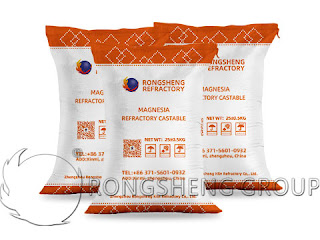
Magnesia Refractory Castable for Rotary Kiln

3. Analysis of the reasons for castable shedding

The change of fuel, especially after the use of anthracite, the coal ash content suddenly settled in a large amount, resulting in the slope of the kiln tail smoke chamber and the frequent shrinkage of the calciner. It needs to be cleaned manually with iron tools, which will inevitably cause mechanical damage to the refractory material. At the same time, the saturation ratio of the raw material entering the kiln fluctuates greatly, and chemical erosion and the infiltration of liquid alkali salts deteriorate the structure of the castable. Reduce thermal fatigue resistance, thermal shock stability, alkali corrosion resistance, and resistance to changes in oxidation and reducing atmospheres. Especially when used in kilns that start and stop frequently, the service life will be greatly shortened. Coupled with clinker dust erosion, erosion, and kiln temperature expansion due to cold and heat, many castables such as the kiln hood, tertiary air duct, and grate cooler have fallen off and failed.

Traditional cement refractory castables can obtain sufficient room temperature strength due to the high amount of cement. However, the crystal transformation of cement at medium temperature will significantly reduce the strength, which leads to the reduction of high-temperature strength and erosion resistance of the material.

Rapid cooling and rapid heating aggravate the frequent accidents of refractory materials. A large number of documents point out that the alkali expansion coefficient is large, and huge thermal stress is generated during the heating process. Therefore, when the kiln is baked, the temperature should be raised slowly, so that the expansion of the kiln system can supplement the expansion of the refractory material to play a compensating role. This is the key to how to use good refractory materials. However, it is difficult to accept a long kiln drying time in actual production, and when a problem is found, the high-temperature fan is directly turned on to quickly cool the kiln temperature. In order to grab the output after the overhaul, it is required to raise the temperature quickly, which paves the way for the damage of the refractory material.

4. Solutions to castable shedding

Different grades of refractory castables are selected for different parts of the pre-calciner kiln system. The shrinkage of the calciner is made of anti-skinning refractory castable, and the kiln hood is made of steel fiber high-aluminum refractory castable. The low wall of the grate cooler is easy to wear and tear, so mullite high-strength wear-resistant castable is used. Corundum castables are easy to burst and fall off when used on coal injection pipes, so steel fiber high-aluminum high-strength wear-resistant refractory castables are used instead, and high-aluminum refractory castables are used for quick repairs during emergency repairs.

Since the castables currently used are basically not crusted, it not only reduces the work intensity of the inspectors but also improves the running time of the rotary kiln stop material cleaning and decomposition furnace shrinkage crusting, which greatly enhances production efficiency.

Rongsheng refractory manufacturer, Rongsheng refractory manufacturer, is a refractory manufacturer with rich production and sales experience. In the design and solution of rotary kiln refractory lining materials, we also have many customer cases. Please contact us to design the configuration of refractory materials for the insulation layer of the rotary kiln for free. Our new type of insulation material products are of superior quality and can effectively reduce the temperature of the outer wall of the rotary kiln.

Process Steps for Producing Alumina Bricks by Molding

Most simple, thick alumina bricks are manufactured using a molding process. Molding (also known as semi-dry pressing) involves placing a bla...