显示标签为“Refractory castable”的博文。显示所有博文

2023年6月25日星期日

Rotary Kiln Refractory Castable Lining for Oxidation and Roasting of Chromium and Nickel-iron Ore

Chromium, nickel-iron ore oxidation roasting material for rotary kiln. A rotary kiln is a special kiln working under dynamic conditions. It is mainly used for calcination and roasting of cement clinker, petroleum coke, magnesia dolomite, limestone, iron oxide magnetization, nickel-iron laterite ore, and non-ferrous metal sulfide ore. Due to the particularity of the working conditions, there are higher requirements for the refractory lining to a certain extent, and the traditional refractory bricks are severely challenged in this type of kiln. According to the working characteristics of rotary kiln, Rongsheng Refractory Co., Ltd. ( http://www.aluminabricks.com/ ) has developed special refractory castables for the rotary kiln series.

Rotary Kiln Anti-Skinning Castable

Refractory Castable for Rotary Kiln

In addition to the common feature that refractory castables for rotary kilns can be used directly without firing, the production process is relatively simple among many types of unshaped refractory materials, and no special equipment is required. Low cement castable for nickel-iron rotary kiln. Many manufacturers' new dry-process cement rotary kiln production lines have improved their ignition and feeding production conditions, and their operating rates have increased year by year. However, there are still some problems with the use of refractory castables. Through comparative analysis, Rongsheng refractory manufacturers have made a summary of the use of refractory castables in the lining of rotary kilns.

1. Rotary kiln refractory castable configuration scheme

High-temperature alkali-resistant castables for preheaters, high-aluminum high-strength low-cement refractory castables for kiln tail smoke chambers and calciners. Corundum high-strength low-cement refractory castables for grate coolers and kiln mouths. Steel fiber high-aluminum refractory castables are used for the kiln hood, and high-aluminum low-cement refractory castables are used for the tertiary air duct. Special castable for corundum coal injection pipe for coal injection pipe.

2. Shedding phenomenon of refractory castable

In many cases, due to the unreasonable design of the configuration scheme, there have been many accidents of pouring material falling off the rotary kiln just over a year after it was put into operation, and the kiln shutdown failure rate is very high. The main reason is that the junction between the calciner and the tertiary air duct has been burned through many times, the shrinkage of the calciner has been worn out, and the tertiary air duct has fallen off. The head of the coal injection pipe burst and fell off three times, the low wall of the grate cooler was worn out, the kiln head cover was burned three times, and the arch beam of the kiln tail smoke chamber collapsed.
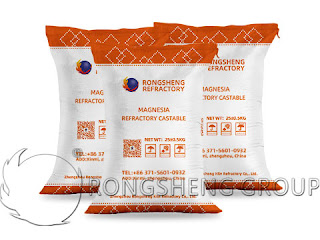
Magnesia Refractory Castable for Rotary Kiln

3. Analysis of the reasons for castable shedding

The change of fuel, especially after the use of anthracite, the coal ash content suddenly settled in a large amount, resulting in the slope of the kiln tail smoke chamber and the frequent shrinkage of the calciner. It needs to be cleaned manually with iron tools, which will inevitably cause mechanical damage to the refractory material. At the same time, the saturation ratio of the raw material entering the kiln fluctuates greatly, and chemical erosion and the infiltration of liquid alkali salts deteriorate the structure of the castable. Reduce thermal fatigue resistance, thermal shock stability, alkali corrosion resistance, and resistance to changes in oxidation and reducing atmospheres. Especially when used in kilns that start and stop frequently, the service life will be greatly shortened. Coupled with clinker dust erosion, erosion, and kiln temperature expansion due to cold and heat, many castables such as the kiln hood, tertiary air duct, and grate cooler have fallen off and failed.

Traditional cement refractory castables can obtain sufficient room temperature strength due to the high amount of cement. However, the crystal transformation of cement at medium temperature will significantly reduce the strength, which leads to the reduction of high-temperature strength and erosion resistance of the material.

Rapid cooling and rapid heating aggravate the frequent accidents of refractory materials. A large number of documents point out that the alkali expansion coefficient is large, and huge thermal stress is generated during the heating process. Therefore, when the kiln is baked, the temperature should be raised slowly, so that the expansion of the kiln system can supplement the expansion of the refractory material to play a compensating role. This is the key to how to use good refractory materials. However, it is difficult to accept a long kiln drying time in actual production, and when a problem is found, the high-temperature fan is directly turned on to quickly cool the kiln temperature. In order to grab the output after the overhaul, it is required to raise the temperature quickly, which paves the way for the damage of the refractory material.

4. Solutions to castable shedding

Different grades of refractory castables are selected for different parts of the pre-calciner kiln system. The shrinkage of the calciner is made of anti-skinning refractory castable, and the kiln hood is made of steel fiber high-aluminum refractory castable. The low wall of the grate cooler is easy to wear and tear, so mullite high-strength wear-resistant castable is used. Corundum castables are easy to burst and fall off when used on coal injection pipes, so steel fiber high-aluminum high-strength wear-resistant refractory castables are used instead, and high-aluminum refractory castables are used for quick repairs during emergency repairs.

Since the castables currently used are basically not crusted, it not only reduces the work intensity of the inspectors but also improves the running time of the rotary kiln stop material cleaning and decomposition furnace shrinkage crusting, which greatly enhances production efficiency.

Rongsheng refractory manufacturer, Rongsheng refractory manufacturer, is a refractory manufacturer with rich production and sales experience. In the design and solution of rotary kiln refractory lining materials, we also have many customer cases. Please contact us to design the configuration of refractory materials for the insulation layer of the rotary kiln for free. Our new type of insulation material products are of superior quality and can effectively reduce the temperature of the outer wall of the rotary kiln.

2023年5月19日星期五

Application of Refractory Mud and Refractory Castable in Coke Oven

Refractory mud is an amorphous refractory material composed of powdery materials and binders for preparing mud. It is mainly used as a binder and coating material for building refractory brick masonry. Most of the refractory mud is mixed with water (or aqueous solution) to make mud. It has the corresponding properties of masonry bricks. According to the recommendations provided by refractory material manufacturers, refractory mud for coke ovens should meet the following requirements.

RS High-Quality Refractory Mud for Coke Oven
RS Refractory Mud for Coke Oven

(1) It should have the necessary cohesiveness after construction and during use. To ensure that it is bonded with the masonry or the surrounding structural layer as a whole, so that it should have the effect of resisting external force, gas resistance and slag erosion.

(2) It must have good fluidity and plasticity to facilitate construction.

(3) Have the same chemical composition as the material of the masonry or surrounding structural layers. In order to avoid the first destruction of the refractory mud, and to avoid adverse chemical reactions between different materials.

(4) It has the same thermal expansion as the masonry or surrounding structural layer material. In order not to separate from each other, the mud layer ruptures.

(5) The volume should be stable and have small shrinkage. To ensure the integrity and tightness of the masonry.

(6) Sintering can occur at the service temperature. To increase the mechanical strength of masonry.

(7) It has a certain refractoriness and load softening point.

In actual construction, the corresponding refractory mortar should be selected according to the type of refractory brick to be built and the operating temperature. That is, clay fireclay is used when building clay bricks, and silica brick fireclay is used when building silica bricks. Concentrate powder must be added to the fire clay for all masonry parts that are in contact with metal embedded parts. When laying bricks on the top surface of coke ovens, hydraulic binders—Portland cement and quartz sand—that can increase the strength should be added to the clay mortar.

Silica fire clay is a powder made of silica, waste silica bricks and refractory clay (raw clay). Silica is the main component of silicon clay. The higher the SiO2 content in the silica, the higher the refractoriness of the fire clay. Adding waste silica bricks can improve the high-temperature bonding performance of fireclay and silica bricks. The reason is that silica brick powder has a thermal expansion curve similar to that of silica bricks. When the volume of quartz crystal transformation changes, the possibility of fire mud detaching from silica bricks is small, and the ability to adhere to silica bricks is good. Generally, the content of silica brick powder is 20%~30%, which is more suitable. Adding raw clay to silicon fire cement can increase plasticity, reduce air permeability and water loss rate. However, the amount added should not be too large, otherwise the refractoriness of the silica clay will be reduced and the shrinkage rate will be increased. Generally, it is advisable not to exceed 15%~20%.

RS High-Quality Refractory Mortar

The requirements for particle size are: no more than 3% of those above 1mm, no less than 50% of those less than 0.074mm. The particle composition of silicon fire clay affects the performance of fire clay. If the particles are too large, the mud will lose water quickly, the bricklaying operation will be difficult, and precipitation and segregation will easily occur in the ash tank. If the particles are too small, the mud is easy to ferment, and the compactness of the mortar joints becomes poor. Generally, after the easy-to-use mortar is hit on the bricks, the bricks can be kneaded and beaten for about 15-20 seconds. This time is related to the particle composition. Therefore, the use performance of silicon cement can be expressed by this time.

Clay fireclay is made by adding refractory clay (raw clay) to clinker or pulverized clay bricks from the calcination process. Clinker is the main component of clay fire mud, accounting for about 75% to 80%. Raw clay is a binder, adding raw clay can increase plasticity, reduce air permeability and water loss rate, but increase shrinkage. Too much raw clay is prone to cracks, so the ingredients account for about 20% to 25%.

The use temperature of clay fire clay is generally lower than 1000 ℃. Clay mortar for coke ovens is generally fine-grained and medium-grained, and the percentage of particles passing through 0.5mm and 1mm sieves should be greater than 97%. In addition to being used for masonry clay bricks, clay fire mortar is also used for repairing coke ovens.
Refractory Castable withstand High-temperature

Refractory castable is a special concrete that can withstand high temperature for a long time. It is a mixture of refractory aggregates, cementitious materials (sometimes with mineral admixtures or organic admixtures) and water prepared in a certain proportion. A refractory product with a certain strength obtained by pounding or vibrating, hardening, curing, and drying.

Bauxite, waste refractory bricks, blast furnace slag, etc. are usually used as aggregates, and bauxite cement, Portland cement, phosphoric acid and water glass are used as cementitious materials. According to the different aggregate materials and cementitious materials, refractory castables are divided into many types. Its composition is different, its properties are different, and its scope of use is also different. Compared with refractory bricks, this refractory product has the following advantages:

(1) Rapidly develops strength at room temperature and does not decrease at operating temperature.

(2) It does not need to be fired before use, which reduces the complicated process of making refractory bricks. The preparation process is simple, and it can be cast into various shapes on the spot, which can reduce the joints of masonry bricks, simplify the structure, and simplify the brick shape. Thereby revolutionizing masonry operations and speeding up construction.

Refractory castables have been used in coke ovens for many years. They are mainly used as riser pipes, furnace door lining bricks, and furnace top rail sleeper bricks instead of clay bricks. They are also used as coke oven roof paving. According to different parts of use, its ingredients are also different.

Although the trial time of refractory castables on coke ovens is not long, it has shown some advantages. However, there are also some shortcomings, such as the softening temperature under load is not high enough, and there are delamination and peeling phenomena during use.

Principles of Refractory Material Configuration for Glass Furnaces

The selection of refractory materials for glass kilns directly affects the kiln's lifespan, glass product quality, and production costs...